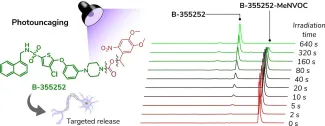
Neurodegenerative disorders and traumatic injuries of the central nervous system constitute a major global health burden, affecting millions of individuals worldwide. Within the human body, numerous bioactive molecules are essential for neuronal development and survival, among which nerve growth factor (NGF) is one of the most critical neurotrophic proteins. Although application of the native protein has been associated with significant limitations, small-molecular NGF mimetics represent a promising alternative. A particularly attractive strategy for targeted delivery is the use of caged compounds in combination with photo-uncaging. In this work, several caged derivatives of the NGF mimetic compounds, B-355252 and LM11A-31, with coumarin and o-nitrobenzyl photolabile protecting groups (PPGs) were developed and characterized. The aqueous solubility of the newly synthesized molecules at physiological pH in aqueous media was determined, leading to the development of a biologically more suitable derivative. The spectroscopic properties and photo-uncaging behaviour of the molecules were also examined in both organic and aqueous media, complemented by density functional theory (DFT) calculations to investigate the uncaging mechanism. High-performance liquid chromatography (HPLC) analyses demonstrated the clean release of the bioactive compounds in aqueous media upon light irradiation of the samples at 365 nm. Finally, a method for determining uncaging quantum yields was developed, using the light-induced E–Z isomerisation process of dimethylazobenzene as a reference reaction.