Oldal címe
SikertörténetekSafe Medical AI: Counterfactual Testing of Chest X-Ray Explanations
Címlapos tartalom
Mohammed Mohaisen
I am a PhD student in the Artificial Intelligence Research Group at the Department of Artificial Intelligence and Systems Engineering, Budapest University of Technology and Economics (BME). My research focuses on trustworthy medical AI for chest X-ray image analysis, with emphasis on explainability, uncertainty, segmentation quality, and active learning. The work is conducted with Gábor Hullám and Dániel Hadházi, aiming to develop methods that make medical AI models more transparent, reliable, and easier to validate.
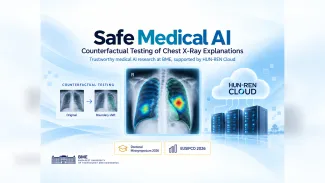
The project “Safe Medical AI: Counterfactual Testing of Chest X-Ray Explanations” investigates how to evaluate the reliability of AI explanations and segmentation models in chest radiography. Rather than treating an explanation map as trustworthy because it appears visually plausible, the research tests whether explanations remain consistent under controlled counterfactual changes and whether uncertainty can identify cases in which segmentation quality may be poor.
HUN-REN Cloud provided the computational environment needed to run GPU-based deep-learning experiments, repeat evaluations across datasets and configurations, and store and process experimental outputs in a reproducible workflow. Access to scalable cloud resources was particularly valuable for iterative model training, inference, explainability analysis, and large experiment batches that would have been difficult to execute efficiently on a personal workstation. The service also allowed the research environment to be maintained remotely and used over extended experimental cycles.
This work has already produced two conference contributions. The first, “Beyond Dice: Strategy-Dependent Acquisition in Active Learning for JSRT Lung Segmentation,” was accepted as a vision paper at the 33rd Doctoral Minisymposium of the Department of Artificial Intelligence and Systems Engineering at BME, held on 9–10 February 2026. It studies how different acquisition strategies affect active learning for lung segmentation, moving beyond aggregate Dice score alone when evaluating what data should be labeled next.
The second result, “SCBA++: Counterfactual Consistency Auditing of Decoder-Focused CAMs for Lung Segmentation in Chest X-Rays,” was published in the proceedings of the 34th European Signal Processing Conference (EUSIPCO 2026), held in Bruges, Belgium, 31 August–4 September 2026. EUSIPCO is the flagship conference of EURASIP. The paper introduces a counterfactual consistency audit for decoder-focused class activation maps in lung segmentation, providing a systematic way to test whether explanation behavior is consistent with controlled changes to the model or input.
These outcomes demonstrate how access to research cloud infrastructure can support a full experimental cycle: from developing and validating methods to producing reproducible results and disseminating them at local and international scientific venues. HUN-REN Cloud has therefore been an important enabling infrastructure for progressing this research on trustworthy and explainable medical AI.