Oldal címe
Success storiesData-driven seasonal weather forecast
Címlapos tartalom
I’m an Associate Professor in Applied Statistics. I leverage my expertise about nonlinear and chaotic dynamical systems. My main interest lies in the forced change of the climate system. I have a track record of studying ENSO teleconnections. My recent interest in ENSO forecasting led me to the more general objective of seasonal weather forecasting.
The current project aims at developing a new methodology for data-driven seasonal forecasting and implementing a global forecasting system. Data-driven methods have the advantage — concerning the forecasting operation itself — of being lightweight in terms of computational demand, and also that no model errors arise as with complex numerical weather prediction (NWP) models implementing first principles of geophysics and fluid dynamics as well as empirical relations. The formulation of a conceptual or statistical data-driven forecast model, however, is challenging because of the nontrivial task of "feature selection", that is, the identification of a rather small set of forecast variables. The fewer and more informative variables the better, because overfitting looses skill. Deep-learning methods aiming at “automatic” feature selection can be extremely demanding computationally, while there is no guarantee that the resulting model has a forecast skill competitive with NWP models. Such a challenge requires specialist insight drawing on statistics, dynamical systems, geophysics, etc.
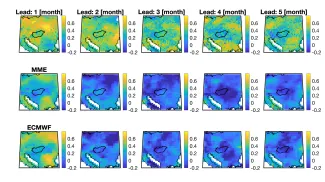
I have obtained promising preliminary results with a new bespoke method. In this exercise, the total precipitation over July is forecast, with lead times from 1 to 5 months. We can see how the forecast skill “persists” with increasing lead time (top), which is not at all the case with NWP models, such as the SEAS5 system of ECMWF (bottom). Synthesising the forecasts made by various different NWP models, taking simply the mean of them, is known to often improve the skill due to simple error cancellation. However, using all 9 models available from the Copernicus Climate Data Store, even such a forecast has virtually no skill at lead times longer than a month (middle). The precipitation data used is the CRU-TS v4.10 product of the University of East Anglia, and it is used for both model inference for the new data-driven forecast and the evaluation of the skill of the NWP models. All other data used for model inference was obtained from the Copernicus Climate Data Sttore.
In the next phase of the project, the forecast will be expanded to all seasons and a live forecast service will be made available online.